

“The inner man has been created in the image of the outer.” – BF Skinner
“We live our lives, as it were, ‘inside out’, projecting the existence of an ‘I’ as separate from an external world which we try to manipulate to gain satisfaction.” – Namkhai Norbu
Introduction
Until better explanations became available, humans personified nature to explain its workings: gods with human looks and emotions have been invoked across cultures as causes behind natural processes, it was once believed that sperm housed little humans, and the mental faculty of foresight is often attributed to blind evolutionary processes that cannot anticipate future states. Fortunately, the scientific method has usurped much of the personified description of nature. Though we’ve realized personification’s inadequacy at explaining natural processes, the common understanding of our inner mental lives – themselves natural processes – hinges upon personification. We wrongly invoke personae (aka “selves”) as the causes behind human behaviour.[1] This oversimplification neglects the formative role of the environment on actions and mental states.
In this essay I will argue that placing a personified subject behind our experience (ie. an “I” or a “me”), while a socially useful and evolutionarily ingrained convention, does not describe reality. That is to say, there is no self located within our heads controlling our mental lives and behaviour from a location behind our eyeballs. This misguided idea has arisen from evolutionary pressure, a language structure that over-simplifies the natural world, the persistence of the doctrine of the soul in secular society, and a failure to observe our own mental lives and behaviour aside from conceptual thought. The dogma of the self psychologically blinds us to a better understanding of human nature and our own subjective experience, both of which provide opportunities to alleviate suffering. Applying logic and observation to the thought and feeling of ourselves shows that we are not brain-residing agents who cause human behaviour. Rather, our traditional view and feeling of self is an effect of neural activity over which no ultimate control exists.
Stuck in Our Heads
The idea that we reside within our heads appears to make sense. Experience feels like it originates from our heads, which house our brains. And after all, brains give rise to our experience. However, we cannot be confined to our heads as we perceive them. Logically, we know that every perception – whether external sights or internal thoughts – results from changes in our brains and nervous systems. How could we exist within our perception of our heads, when the external world is also experienced through neurophysiologic changes inside our heads? Every perception, internal and external, is actually part of our inner experience.
Think about what’s happening right now. As you read these words, they seem to exist outside of you, while any understanding of them feels like it happens inside your head. But both your understanding and the physical appearance of these words arise through your internal nervous system! Likewise, when you look at another human being, you only know them through appearances within your mind. Whether looking at these words, a friend, or the night sky, you’re looking at the inside of your own mind.[2]
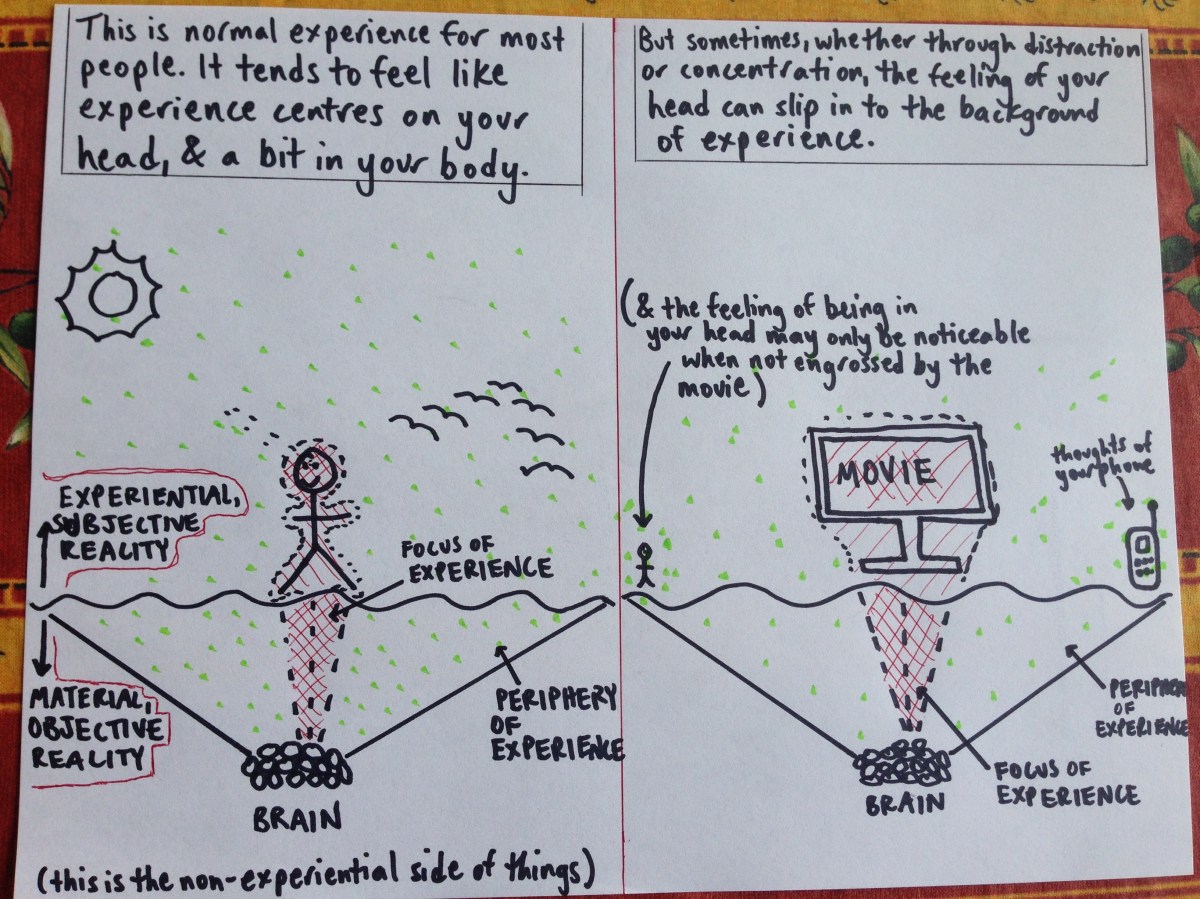
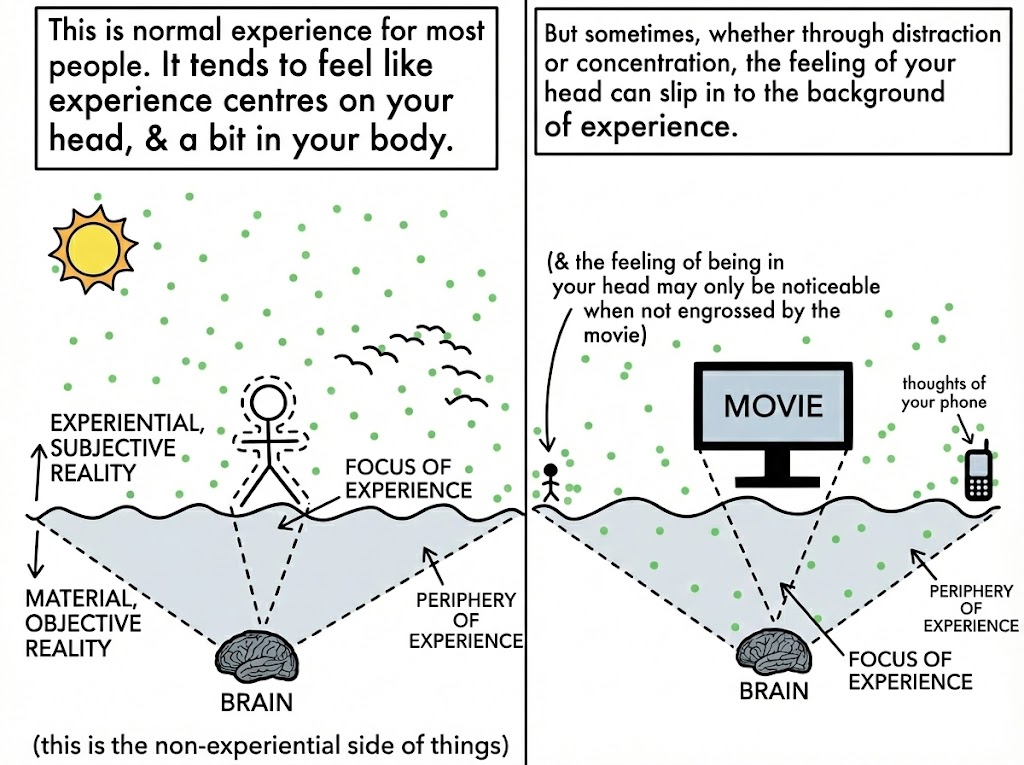
Because no dichotomy exists between the experience within and that outside of our heads, we can think of all experience as contained within a global awareness. Our experience of the world is a transient field of perceptions differentially occupying this awareness. Heads (as we experience them) are not privileged centres of experience – they’re just another perception within awareness. As the philosopher Sam Harris has said, “Your awareness is not in your head. Your head is in awareness.”[3]
We are so programmed to feel sealed within our skulls that this counter-intuitive idea is difficult to grasp in an enduring way. Therefore I’ve drawn a picture to aid in understanding it.
Control Does Not Exist
Notions of control cannot ultimately explain natural phenomena because the idea of control pre-supposes a unilateral relationship. But all relationships work multiple ways. A controller-controlled duality only appears when considering a narrow slice of space-time from a biased perspective. A controller-controlled duality can never provide a full description of reality. No system has ever, fundamentally, had a controller. ‘Control’ only exists relative to that which is ‘controlled’, and relative relationships present no possibility for absolute reference points from which absolute control could originate. For instance, consider the control exerted by authoritarian governments over controlled populations. A slight change in view reveals the oversimplification in such a statement.
Authoritarian control is itself controlled by a near infinitude of factors including: the level of subservience of the ‘controlled’ population, social and political histories, geographic and climactic conditions, relationships among the ‘controlling’ regime, and countless other assortments of ultimately uncontrolled events (rolling as far back as the beginning of time). Labels of ‘controller’ and ‘controlled’ make for easy explanations of natural systems but because control can be assigned to a limitless number of influential factors depending on your point of view (and definition of control), control can never provide a complete description of nature. Nature is not that easy; she consists of innumerable interactions in complicated interrelated equilibrium. Equilibriums, as the name suggests, are balanced processes that never allow privileged positions of control.
As with oppressive governments, we can only consider ourselves as controllers because we are ignorant of most factors influencing our behaviour. Felt experience exists at the crest of unimaginably complicated processes and the influential churnings beneath awareness remain hidden from us. The universe appears to have begun as an uncontrolled process. Stars formed, rocks smashed together, and solar systems coalesced without anything resembling external guidance. Because everything throughout the universe’s web of causation exists relative to (ie. in relation to, and in equilibrium with) everything else, there has never been a conceivable opportunity for absolute control to emerge. Even awareness, commonly relied upon as the miracle behind free agency, exists amongst a slew of limiting factors (limiting, of course, only when considered from the point of view of a reality allowing for free agency). As biological evolution progressed the universe became considerably more complex. This complexity led to the illusion of control and the illusion of the self. Considering simpler organisms may help shake us from our privileged notions about the selves of ‘higher organisms’.
Organism-Environment Relationship
Evolution has not formed a locus of internal control in animals with more complex brains. Increasingly complicated nervous systems give the appearance of central agents, but that appearance is produced by imperceptible interactions between organisms and environments, and feedback cycles produced within nervous systems. ‘Control’ amongst simple organisms is clearly identifiable as relational to the environment and nervous systems (and not the product of an inner ‘self’). Cnidarians, with their primitive nerve nets, provide a good model.
Touch a sea anemone and it retracts its tentacles. These tentacles then stay retracted for a period of time before the anemone resumes its relaxed posture. Nobody (with even a slight handle on the subject matter) would be tempted to suggest that an agent residing within the anemone chooses to retract the tentacles, hold them in for a while, then release them, because the simplicity of the stimulus-response can be easily followed. The anemone doesn’t need a central agent to retract its tentacles because when the environment and organism are in a particular state (ie. in some kind of contact), the response just happens. Increasingly complex nervous systems can process increasingly subtle environmental stimuli to produce responses, and can generate many feedback loops affecting other parts of the nervous system. Just as the anemone has no residing controller, though, neither do complex nervous systems, even though nervous systems may produce the feeling and appearance of having a controller.
And, really, how could you ever control something as complex as your nervous system? To many, the act of thinking epitomizes control, but staggeringly intricate neural processes are required for even the simplest of thoughts. Most humans can barely juggle three items; how could we (ie. in the form of “me”, or “I”) coordinate millions of neurons to produce thought? The feeling of controlling thought is a subconsciously-originating expression of our nervous systems, but the felt control is never the cause of thoughts themselves. Both felt control and thought exist as objects in awareness, produced by the vast complexity behind awareness.[4] Thoughts result from configurations of our nervous systems and surrounding environment, and although we may be able to post-hoc rationalize why we chose to think a certain thought (or act a certain way), such rationalization is an epistemologically unreliable expression of our nervous systems based upon feedback loops from previous states of our nervous systems (which is to say, we are fooling ourselves by pretending to know the full causes behind our behaviour).
Just as sea anemones react to their environment without deliberation, we think without needing to think about how we do it, because thought results from cascades of nervous system configurations lying outside of awareness, requiring no controller. Although the nervous systems of sea anemones are obviously simpler than our own, we can extrapolate based on fundamental principles of biology (not to mention the fact that we live in a universe of cause and effect which, as stated earlier, provides no room for absolute control).
Evolution by natural selection proceeds in steps, building upon previous iterations. Because all aspects of current life forms are based upon past – often simpler – life forms, every aspect of life is reducible (and even the earliest life forms are reducible to their constituent inanimate parts). The evolution of our nervous systems was no different. Our nervous systems and emergent experience should theoretically be reducible (and if they aren’t, they are an anomaly in the entire field of life and universe at large). A non-reducible controller, existing apart from the organism-environment relationship, could not have arisen through evolution because natural selection selects traits based on their interactions with the natural environment.[5] Inserting a godlike controller between life and the environment contrives a duality between ‘self’ and ‘other’ which western religion and philosophy have failed to explain. When such inquiry is premised on a non-existent irreducible self, failure is expected.
Modern Science, Eastern Religion, and Altered States
Modern scientific inquiry has begun logically disassembling different modes of operation of our nervous systems, and various traditional introspective philosophy-religions provide techniques to break down felt experience. Science and introspection both reveal that no coherent entity controls mental phenomena or human behaviour (unless, of course, you consider the entirety of space-time as your coherent entity). Rather, human nature is expressed through a number of different mental modes working in series, parallel, and sometimes even competing with each other. For instance, brain damage has shown that the neural machinery responsible for recognizing plants, animals, and tools are each contained in different areas of the brain (and can be individually knocked out). No cohesive self exists which is capable of identifying those three categories of objects. Localized networks in the brain carry out the recognition. When such recognition is expressed within our awareness, a person may feel that the proverbial “I” is responsible. Look at a fruit, though, and it’s evident that the recognition requires no conscious input whatsoever by whatever constitutes the feeling of being a self. If you notice an apple, ‘you’ can’t help but recognize it as an apple.
Many yogic techniques cultivate attention in ways that break the illusion of a central controller running behind felt experience. Some practices, such as those in the Dzogchen tradition, shift the perspective of attention to reveal the feeling of self as a mere pattern of thoughts and sensations. Others, such as those in the Vipassana tradition, seem to intensely apply concentration on physical sensations, so that thoughts and feelings of self do not arise (presumably because so much neural processing power is devoted to sensation, neural circuits responsible for the feeling and thought of self do not engage). Science, the most reliable method for understanding and describing the world, involves a mixture of logic and empiricism. We use logic to make predictions, then test them with close observation. Ancient techniques for self-observation allow us to experience the logical statements of modern brain science. Without such techniques, the truth about our lack of self would be relegated as an impractical scientific titbit.
People’s illusory sense of self sometimes spontaneously interrupts and they identify with their entire field of awareness, or experience awareness as a field without any reference point (which is normally the head). Although these self-less experiences may be written off as mere brain hiccups, they represent an experience that accords with reality: everything happens with no self behind the happening. Literature on such states of mind abounds with absurd statements about the universe, but the phenomenon itself makes sense. Awareness (ie. the entire subjective world) is produced within nervous systems and the localized sense of self is also produced within nervous systems. By disrupting the sense of self, naked awareness remains, now without felt distinction between ‘self’ and ‘other’. Our nervous systems produce awareness from within our skin. Although objects in awareness normally seem separate from our self, everything within our awareness is actually an intimate part of us, because everything in awareness has an analogue within our nervous systems. For example, the information content of these words exists within your nervous system, otherwise you could never read them.
The 20th century naturalist Loren Eiseley described such a mental state in The Immense Journey. “Once in a lifetime, perhaps, one escapes the actual confines of the flesh. Once in a lifetime, if one is lucky, one so merges with sunlight and air and running water that whole eons, the eons that mountains and deserts know, might pass in a single afternoon without discomfort. The mind has sunk away into its beginnings among old roots and the obscure tricklings and movings that stir inanimate things. Like the charmed fairy circle into which a man once stepped, and upon emergence learned that a whole century had passed in a single night, one can never quite define this secret…” Similar mental states were likely historically communicated by religious figures, but misunderstood in subsequent generations.
Take Jesus, who identified with God and encouraged loving your neighbour as yourself. Before being institutionally warped, Jesus’ message matched the teachings of eastern philosophy-religions. Hinduism states that everyone is identical with the transcendental Brahman (aka God, or the universe), and Buddhism incorporates the recognition of anatta (meaning no-self) in its method for liberation from suffering. Seeing through the illusion of the self makes one more likely to love a neighbour as they love themselves. Some Buddhist practices (see Metta meditation) even encourage states of consciousness conducive to unconditionally loving all beings.
Evolution
If the self doesn’t exist as we think and feel it to exist, why is it such an integral part of our psychology? At its core, the self is a survival mechanism. All of life survives by differentiating its insides from the world outside, which is necessary for protection. Even the earliest life forms had to protect themselves from the entropic forces outside of their ‘skin’. As life became more complex, and experience evolved as a mechanism for guiding behaviour, blind physical and biochemical reactions that had sufficed to seal organisms’ insides from the dangerous outside were at risk of being overridden. A psychological sense of separateness from the outside world and anxiety about ambiguous stimuli discouraged organisms from entering dangerous situations. Selection pressures favoured this sense of separateness amongst life forms which are actually inseparable from the surrounding environment. Our resulting sense of self feels more concentrated in parts of our bodies more crucial to survival.
We identify most with our face, feeling ourselves to reside somewhere behind its upper half. It makes sense to feel like we predominantly exist within our heads, because heads are essential to survival. Heads contain brains and important sensory apparatus, and faces mediate social interactions (and, being social creatures that collaborate and reproduce sexually, social interactions are also essential to human survival). When we feel self-conscious, we often get a sense of anxiety in our faces, but also in our chests and stomachs, which are home to important organs that must be protected. I know of nobody who feels self-consciousness arise within their feet, although they may feel self-conscious about their feet. Nobody instinctively uses their head or body to protect their limbs, but we all behave contrariwise.
We also tend to identify with ideas, becoming overly emotional when certain ideas are criticized or praised. Few ideas are held closer to a person’s sense of self than religious beliefs. Criticism or praise of different belief systems regularly conjures strong emotions, for good or ill. Outrage over immaterial mental projections makes sense when we acknowledge the importance of ideas to survival (and consequently, the selection pressures to emotionally identify with ideas). Humans are primates that found an ecological niche through tool use. The formation of any physical tool first hinges upon its inception as an abstract thought. Thus, thoughts and ideas have been as important to the flourishing of our species as protecting our insides from the outside. Emotions associated with our sense of self, protective of our physical bodies, extended to our ideas.
Others’ ideas about us, and our ideas about other’s ideas about us, both influence social interactions. Because survival of our species has relied upon social interactions, our sense of self is strongly influenced by what we think others think of us (in today’s technological age of constant connection, this aspect of self regularly devolves into obsession).
Few ideas agitate people more than questioning of the self and agency, which is a harmless venture (aside from the temporary uneasy ground associated with paradigm shift’s in one’s view of reality). Unfortunately, such agitation plays a part in keeping our philosophies of mind in the dark ages. Modern culture has been reasonably successful at shedding nonsensical ideas about how the world works. The scientific method has revealed many of the counter-intuitive workings of the world, precipitated by acknowledging uncertainty to recognize questions worth asking. Ontological development progresses by indiscriminately questioning set notions about natural phenomena. Why, then, hasn’t our culture seriously questioned the absurd idea that we have self-contained controllers living in each of our skulls, that are unconstrained by physical law and exist outside of the relationships woven into the fabric of existence?
Religious Influence
Western secular society exists in the throes of Abrahamic religion, and is well steeped in the doctrine of the soul. Our culture grew from a climate where almost everyone believed in the soul as the non-material “prime mover” behind human thought, emotional states, and behaviour. Today, although many people acknowledge the material basis of mental phenomena, we essentially believe that our material nervous systems may be manipulated by a soul-like “prime mover”. That is, we believe in a centralized source behind our actions, capable of existing apart from influence by the surrounding universe. Aside from acknowledging the self’s inevitable demise, self and soul are functionally synonymous.
Powerful religious institutions have suppressed dissenting views that threaten the legitimacy of the soul-self creed. Mystics throughout the ages employed practices and made claims similar to those of eastern philosophy-religions. Take Meister Eckhart, a Christian mystic of the Late Middle Ages who said, “The eye through which I see God is the same eye through which God sees me; my eye and God’s eye are one eye…” Meister Eckhart, like Jesus and Hindus before him, identified with God (a non-theist would say that Meister Eckhart realized that humans and the universe are one). Meister Eckhart was accused of heresy by the Catholic Church, which – ironically – has killed many people for professing similar insights to Jesus, eastern religions, and many mystics.
By silencing dissenters (through death, exile, torture or imprisonment) the church effectively discouraged proliferation of techniques similar to those found in Buddhism, whereby skilful attention can illuminate the lack of self. And seeing through the illusion of self permits the realization that our thoughts and actions are inseparable from the spontaneous flow of the universe (Meister Eckhart would say that we’ve realized our Oneness with God). Meditative practices are gaining a foothold in the modern consciousness of the west, albeit often as mere stress-pills for improved efficiency, which attitude may hinder cultivation of more subtle mind states. Without the skilled use of reliable techniques, applied attention may never suffice to dispel the self. The neural pathways behind our intuitions about self were established on geological timescales and reinforced over a lifetime. It’s no wonder we have been fooled. Logic and close observation – the tenets of the scientific method – have often proved misleading when turned inward on ourselves, because flawed logic veils our “self-observation”. That is to say, we confuse biased thought about our behaviour with behaviour itself. And the language structure of those biased thoughts do not adequately describe any natural process (see Nouns and Verbs and Things), let alone a process so complicated as agency and behaviour of human beings.
Influence of Language
Our language accepts the self as a given and grants it the impossible power of being a first cause. No satisfactory definition of self has ever been given (how could it, when we’ve tried to oversimplify something beyond our understanding that doesn’t actually exist?), but we accept statements involving “I’s”, “me’s”, and “mine”, as faithful linguistic representations of reality. This “I”, which exists as a centre and source of experience in our language, likewise exists in our thoughts. And because we habitually organize and understand our reality through thought, we understand ourselves through the lens of language. When attempting to feel out different aspects of our experience, we generally just return to thoughts of our experience, so that thoughts of ourselves as some separate other (ie. “I” or “me”) frame most of our experience. In this way, non-conceptual experience becomes obfuscated by the concept of self. We must realize language’s shortcomings at conveying reality, otherwise language will always blind us to truth.
By attempting to more accurately describe human agency and behaviour, language would become unwieldy. I could describe a situation as, “an indeterminate shape preceded the arising of energetic fear in awareness (the only awareness in which it could arise at that moment, conventionally referred to as “mine”) which immediately preceded complicated physiological responses leading to the jumping of the human being conventionally known as tbonejames, immediately followed by the recognition arising in awareness of a snake”, but it’s much easier to just say, “I jumped because I saw a snake”. We should remain privy to the deficiencies inherent in the convenience of language. As we know that sunrise and sunset are actually the earth turning because of gravity wells and conservation of momentum beyond most people’s understanding, though, so we should realize that the self places a box around a phenomenon that is actually perforated with holes. A lifetime of recursive linguistic thinking reinforces the idea of ourselves as some kind of singular causal agent. Sufficient awareness of the reality behind language can help lessen language’s pernicious effects, which cleave us from the world of which we are a part. Along with erecting a dualism between ‘self’ and ‘other’, language can lead to cognitive dissonances that frustrate attempts to modify behaviour.
Consider self-control. The importance of self-control is consistently touted, but if there is no self (or control), how could there be self-control? Even were there a self, how could it possibly control itself? Like most behaviour, self-control involves a few different modes of the brain and, when broken down, is more complex than suggested by common parlance. First, a compulsion spontaneously arises in awareness (perhaps with some level of predictability based on past behaviour). Then, rather than act on the compulsion, the compulsion is recognized as a transient object of awareness. The compulsion is then held in awareness until it eventually subsides. Self-control can be more accurately described as “sustained awareness of compulsions without subsequently acting upon them.”
People may claim that they have good self-control because they consciously become aware of their compulsions and consciously choose not to act on them. But such a position mistakes habit patterns of the brain, which depend on previous experience and physiological make-up, for a self actually tinkering within the brain. Like the compulsion, the recognizing awareness also arises spontaneously. After all, if someone fails to recognize an object in awareness, then couldn’t that person also be said to be failing to recognize everything that wasn’t within their awareness at that moment? Is it that person’s fault that at that moment they failed to think of a blue panther (ie. to recognize a blue panther in awareness)?
Influence of Emotion
Encouraging awareness of important objects of attention is useful, but where credit or blame heightens ego or anxiety, more psychologically neutral methods of education should be preferred. Because we are ultimately mere witnesses of spontaneous natural processes, nobody deserves credit, and nobody deserves blame, although sometimes credit and blame may be the most effective way to encourage better behaviour through their powerful influence on human emotions. There is no room for genuine fault in human affairs. Different people’s brains simply behave differently. That said, habit patterns of the brain can be used as predictors for future behaviour, and various methods can be used to change those habit patterns.
Judgments about ourselves and others strengthen the cognitive illusion of separateness from the universe. Assigning credit or blame to a system reinforces the false notion that such a system could exist in isolation. Conversely, when nonjudgmental about systems, we easily accept them as integral to the universe. Think of the asteroid belt: here exists a natural process that you’ve likely never judged, but is commonly understood as part of the universe existing in relation to the surrounding universe. Knowing what we know about the universe, it would be weird if the asteroid belt didn’t exist, or existed in a substantially different form. The asteroid belt is inseparable from the universe. Now think of a computer when it’s misbehaving: here exists a lousy machine that should be better. Given the current state of the universe (which includes the computer) it could not be anything but a lousy machine in such circumstances. The misbehaving computer is as much a part of the universe, and as inseparable from the universe, as the asteroid belt. But we don’t feel this way. We feel that, once something in our life irks us in some way, that it should somehow be different. That is, it should be different even though everything else remains the same. But the only way that something could be different in any given moment is if the rest of the universe were also different in that moment because, ultimately, everything exists in relation to everything else.[6] This includes human beings. Judging one part of the universe, without judging formative surrounding influences, may feel right but it doesn’t make sense. As the psychologist and behaviourist BF Skinner wrote, “A scientific analysis shifts the credit as well as the blame to the environment, and traditional practices can then no longer be justified. These are sweeping changes, and those who are committed to traditional theories and practices naturally resist them.”
Conclusion
The self is merely a thought that, like many thoughts, impedes bare experience. Connecting with experience, rather than experiencing abstract thoughts, connects us to a reality unconfined by narrow ideas of self and other. This way of thinking is a source of compassion. Understanding that we exist as spheres of experience modulated by our nervous systems, and not as selves subjectively operating in an ascertainable objective reality, encourages dialogue rather than brute judgments. Understanding that everything about a human – including thought – is a spontaneous process of the universe can help break recursive thinking about ourselves, which plagues our society. Understanding this truth highlights the importance of education, rather than punishment, to promote meaningful relations and good behaviour. No self can stand aside from criticism to tweak behaviour. Because we believe that a static self does exist, though, criticism can trap us within crippling habitual thoughts (and paired emotional states) about the perceived inadequacies within our selves. But the mode of the brain perceiving the inadequacies is different than the mode of the brain responsible for behaviour, so loops of self-criticism are neither useful nor logical.
The universe is complex. As entropic forces bring chaos to much of the universe, some pockets of it – by chance alone – are situated such that order and entropy interact in wonderful ways. Our solar system is one such pocket, and as time has passed, the state of the universe known as earth has become successively more complex. Understanding this complexity is an ongoing task that requires us to repeatedly change our views. If we are concerned with truth and wellbeing, we must change our view of human nature. Without further investigation or education, intuitive thinking cannot explain ourselves. We are apes with our share of hubris. Intuition does not suffice to describe nature. We see plants, animals, and tools as singular things, because this view of the world has been conducive to our survival. Likewise, we feel and view ourselves as indivisible centres of experience, because such a way of existing has been conducive to our survival. Never, though, has inquiry into nature revealed an indivisible coherent entity (if this statement offends any physicists, I apologize for my ignorance). No one would be tempted to say that grass grows because it has a ‘grower’ behind it.[7] Grass just grows. Attempts can be made to explain its growth, but none of those attempts will be successful if they anthropomorphize the grass to say that it has a ‘grower’ behind it. Likewise, there is no ‘doer’ behind what humans do; there is just what humans do (and the feeling that there is a ‘doer’ behind it all is just a part of what humans do). Many of us in modern liberal democracies lead privileged lives, free from immediate threats to individual survival. If we want to ever be able to understand and explain human behaviour, we should use our freedom to intellectually and emotionally realize the truth about our lack of self.
[1]I’m substituting “we” for “the majority of nonreligious people in modern western society” for word economy.
[2]I’m using mind in its most general sense, as opposed to mind as certain modules of mental life. And in case it’s unclear, I should note that I’m not advocating solipsism.
[3]Close your eyes and plug your ears. You still have a sense of the outside world with a kind of quasi-visual and audio quality, within which your head feels like it exists. But that outside world which you sense is almost entirely a product of your nervous system because you’ve cut off your vision and hearing, so how could your head exist within it?
[4]This is not to say that awareness of objects doesn’t influence behaviour. It does to a huge degree. But the ways in which it influences behaviour are beyond conscious control.
[5]Natural environment here including internal feedback loops and the external “environment”; because, really, the environment includes everything in it; there are no closed systems within our universe.
[6]In the case of the computer, wiring, assembly line workers, air humidity, past impacts, software, our own knowledge etc. could all be influences on the judgment singularly placed on the computer.
[7]Unless attributed to God or gods.

 Stories From the Ground.